Family Constellation Therapy offers a unique lens for understanding these patterns. Rather than viewing you as an isolated individual, it treats your family as an interconnected system where unresolved traumas, hidden loyalties, and emotional dynamics can ripple across generations—shaping your behavior, relationships, and mental health today.
This guide will walk you through what Family Constellation Therapy is, how it works, what the research says, what to expect in a session, and how to find a qualified facilitator who practices ethically and effectively.
Key Takeaways
- Uses spatial positioning and representatives - other people in a group setting or objects in an individual session - to surface unconscious family patterns and intergenerational trauma
- Sessions range from 60-120 minutes for one constellation to multi-day workshops
- Facilitator skill, ethics, and client readiness strongly shape outcomes
What Is Family Constellation Therapy?
Family Constellation Therapy is a therapeutic approach that makes unconscious family dynamics visible by representing family members spatially in a therapeutic setting. Instead of sitting in a chair and talking, clients create a "living map" of their family system using other people (in group work) or objects like figurines or paper markers (in individual sessions).
Think of families like constellations of stars: each member connected by invisible gravitational lines, creating a unique shape and pattern that influences how every individual moves and behaves. When one star shifts, the whole constellation adjusts.
The method rests on three foundational principles:
- The need for belonging – Every family member has a right to be part of the system
- The need for order – Families have natural hierarchies; parents come before children, older siblings before younger
- The need for equilibrium – Healthy systems balance giving and receiving
When these principles are violated through exclusion, role reversals, or unresolved trauma, descendants may unconsciously carry the burden, even generations later.

Group vs. Individual Sessions
Group constellation work typically involves 15-30 people. The client briefly describes their issue and selects volunteers to represent family members: parents, siblings, grandparents, even deceased relatives. These representatives stand in the room based on the client's intuitive sense of where they belong.
Representatives often report physical sensations, emotions, or impulses connected to the person they're representing, even without knowing that person's history.
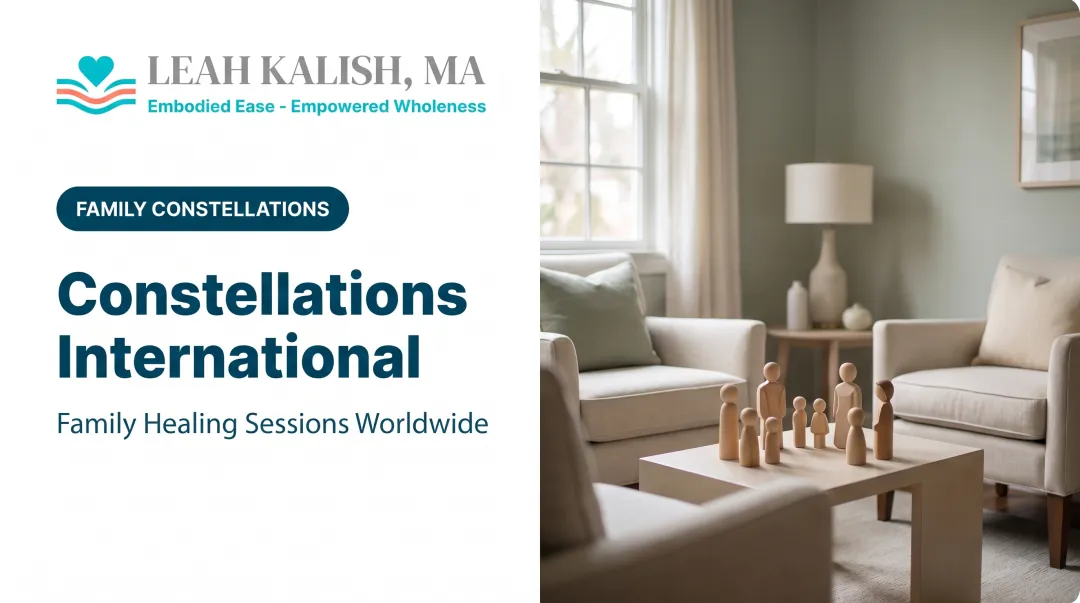
Individual constellation work uses objects instead of people: figurines, paper cutouts, stones, or sand-tray miniatures. The client arranges them on a table or floor to map family relationships. The facilitator guides the client to notice spatial distances, directions, and emotional responses as they move the objects and explore what shifts.
Both formats aim to reveal the same hidden dynamics: Who's been excluded? Where are the entanglements? What needs to be acknowledged for balance to return?

How Family Constellation Therapy Works
A Family Constellation session creates a "living map" of the family system. Spatial positions, the direction representatives face, physical distance, and even posture reveal unconscious dynamics.
The Role of Representatives
In group work, chosen representatives often describe experiencing emotions, physical sensations, or thoughts connected to the person they're standing in for, without being told that person's story. Some report feeling heavy, anxious, angry, or drawn toward or away from other representatives.
Practitioners sometimes attribute this phenomenon to a "knowing field," "morphic resonance," or the collective unconscious.
Regardless of the mechanism, the experiential feedback (what representatives feel and say) drives the facilitation process.
The Facilitation Process
Typical steps:
- Client shares a brief family history – The facilitator asks selectively about key events: deaths, adoptions, abuse, exclusions
- Representatives are chosen and positioned – The client places them intuitively, then steps back to observe
- Facilitator asks for feedback – Representatives describe sensations, impulses, or emotions
- Repositioning and intervention – The facilitator may move people, introduce missing family members, or guide healing statements like "I see what happened to you, but it's not my burden to carry"
- Client steps into their own position – This helps integrate insights experientially rather than just intellectually
Empty spaces in the constellation may indicate excluded or "forgotten" family members: those who died young, were given up for adoption, or whose existence was never spoken about.

Uncovering Intergenerational Patterns
Family Constellation Therapy helps identify patterns that repeat across generations: chronic anxiety, depression, relationship sabotage, addiction, or feeling perpetually "stuck."
These patterns may stem from:
- Unprocessed grief for a family member who died young
- Excluded relatives (such as a half-sibling no one talks about)
- Traumatic deaths (suicide, war, accident)
- Family secrets (abuse, adoption, infidelity)
When these events remain unacknowledged, descendants may unconsciously "carry" the unresolved emotion, experiencing it as their own.
Ancestral and Collective Healing
Some practitioners extend constellations beyond immediate family to explore how cultural trauma, war, displacement, slavery, or genocide influence present-day psychology. This aspect has particular relevance for adoptees, immigrants, and descendants of historical trauma.
Collective experiences leave imprints that shape identity, belonging, and worldview, even when individuals weren't directly involved.
Benefits and What It Can Help With
Clients often report three primary benefits:
- Powerful emotional releases and catharsis – Seeing family dynamics externalized can trigger sudden grief, relief, or clarity
- Cognitive insight into toxic patterns – Understanding why you repeat certain behaviors helps you choose differently
- Relational shifts – Recognizing how family dynamics influence current relationships opens pathways for healthier connection
Common Issues Addressed
Family Constellation Therapy is often used for:
- Childhood trauma
- Grief and loss
- Adoption-related wounds
- Depression and anxiety
- Relationship conflicts
- Feeling stuck or unable to move forward
- Intergenerational trauma
The approach does not claim to treat specific psychiatric diagnoses, and no condition-specific evidence was identified in the research reviewed.
The Evidence: Does It Really Work?
Research on Family Constellation Therapy is limited in quantity and quality, with mixed results.
Promising early findings:
A 2021 systematic review analyzed 12 studies involving 568 participants and found that 9 out of 12 studies showed significant improvement in mental health outcomes after Family Constellation interventions.
A meta-analysis of five studies produced a moderate effect size (Hedges' g = 0.531), suggesting meaningful benefit for participants.
Even without a proven unique mechanism, clients may benefit from:
- Strong therapeutic relationship and felt safety
- Insight development through spatial representation
- Emotional processing in a supportive group environment
- Expectancy and placebo effects
Effectiveness depends heavily on facilitator training and skill. Poorly conducted sessions may have no effect or may even cause harm, especially when facilitators lack trauma competence or push clients beyond their capacity.

What to Expect in a Family Constellation Session
Most sessions follow a similar arc: you name the issue, a living map of the family or system is set up, and new information surfaces through the constellation. Formats and length still vary:
- Individual sessions – typically 1–2 hours, in person in Los Angeles or via Zoom
- Group workshop constellations – about 60-120 minutes per issue
- Full-day workshops – 6–8 hours, with several clients presenting
- Multi-day seminars – two or three days of deeper group work
Family Constellation Therapy is usually a brief intervention—one session or a few—rather than ongoing weekly therapy.
Preparing for Your Session
- Name the issue you want to explore beforehand, such as a specific relationship, recurring anxiety, or feeling stuck
- Plan self-care afterward—sessions can stir intense emotions or memories
- Consider talk therapy before and after to help process what comes up
What Happens After a Session
Insights often keep unfolding in the days and weeks after a session. Some people feel immediate relief, lightness, or resolution. Others feel temporarily unsettled as old patterns loosen.
Follow-up support through regular therapy can help integrate what emerged and turn insight into lasting change.
Finding a Family Constellation Facilitator
Choosing a skilled, ethical facilitator is critical.
What to look for:
- Proper training from recognized institutes such as the International Systemic Constellations Association (ISCA) or similar organizations
- Clear ethics around informed consent, confidentiality, trauma competence, scope of practice, supervision, and referral
- Clinical licensing (if applicable): many facilitators are also licensed therapists, counselors, or social workers—verify credentials
- Approach alignment: confirm they do not follow Hellinger's later problematic views or practices such as asking abuse survivors to "thank" their abusers
Questions to ask:
- What clinical license and constellation-specific training do you hold?
- How do you screen for trauma, psychosis, crisis, and suitability?
- How are consent and group confidentiality handled?
- What happens if a participant becomes overwhelmed?
- What supervision and referral relationships do you maintain?
- How do you distinguish symbolic insight from factual family history?
Those same checks—training, ethics, screening, and scope—also help you evaluate local facilitators and whether their style fits your goals.
Family Constellation Therapy in Los Angeles
In the Los Angeles area, Leah and Bruce Kalish facilitate Family Constellations with a focus on nervous system regulation, trauma release, and adoption-related healing. They were certified in 2009 by Mark Wolynn, founder of the Family Constellation Institute and author of It Didn't Start with You. Wolynn has called them "masterful facilitators, bringing warmth, depth, wisdom and compassion to those whose hearts they touch."
Their work pairs systemic constellation sessions with the Embodiment Process, a body-based somatic practice used to help clients integrate insight at a nervous-system level. Formats include:
- Individual, couples, and group constellations
- In-person sessions in Los Angeles and remote sessions on Zoom
- Work with individuals, adoptees, families, and mental health professionals (personal healing and practitioner development)
Frequently Asked Questions
What is family constellation therapy and how does it work?
Family Constellation Therapy is a therapeutic method that uses spatial representation of family members to reveal hidden dynamics and intergenerational patterns. Clients gain insight into how family traumas and loyalties influence their behavior and relationships today.
What happens in a family constellation session?
The client shares a brief family background. In group work, representatives stand in for family members; in individual work, objects are arranged instead. The facilitator guides positioning so the client can see patterns that may still shape their life.
How long does a family constellation session last?
Session length varies widely: individual sessions typically last 1-2 hours, while a single constellation in a group workshop may take 60-120 minutes. Full-day workshops run 6-8 hours, and some trainings span multiple days.
How much does family constellation therapy cost?
Costs vary by location, format, and facilitator credentials—there is no standard rate. Ask facilitators for current fees, and check with your insurer whether coverage applies based on the provider’s license and your plan.
Does family constellation therapy really work?
Research is limited and mixed: early studies and many client reports were promising, while newer randomized trials found weaker support. Results depend heavily on facilitator skill and the client’s readiness for the work.
Can you give an example of a family constellation?
A client with chronic anxiety might discover they are unconsciously carrying grief for a grandmother who died young. Repositioning that relationship in the constellation, and symbolically returning the burden, can bring relief and permission to live their own life fully.