That's where somatic breathwork comes in. It's a body-based practice that uses intentional breathing patterns to influence the nervous system and help release emotional tension that talk-based approaches sometimes miss.
This article covers what somatic breathwork actually is, how it works, five techniques you can try today, safety considerations, and when to consider pairing it with deeper modalities like Family Constellation work.
Key Takeaways
- Somatic breathwork uses intentional breathing to regulate the nervous system and release stored tension
- It goes beyond general breathwork by targeting the body-emotion connection, not relaxation alone
- Core techniques include diaphragmatic breathing, box breathing, and cyclic sighing
- It's generally safe, but certain groups should check with a professional first
- For deep trauma, family patterns, or adoption wounds, guided breathwork often creates more lasting shifts
What Is Somatic Breathwork and How Does It Work?
The word "somatic" comes from the Greek sōma, meaning body. Somatic breathwork treats breath as a bridge between the physical body and emotional experience, not just a relaxation tool.
Bottom-Up vs. Top-Down Processing
Talk therapy works largely "top-down": you use thoughts and language at the cortex level to process feelings. Somatic breathwork flips that. It's a "bottom-up" approach, starting with physical sensation and moving upward toward the brain. Research on mind-body pathways notes that this distinction, while useful, is a simplification. Most mind-body practices actually use both pathways together.
Your Nervous System's Two Gears
Your autonomic nervous system runs on two main settings:
- Sympathetic (fight/flight) — activated, alert, ready to react
- Parasympathetic (rest/digest) — calm, settled, able to recover Breathwork can shift you between these states. Slow breathing, in particular, has been linked to increases in heart rate variability (HRV), a marker of better nervous system flexibility. Those gains show up both right after a single session and across multi-session programs, according to a 2022 review of voluntary slow breathing.

Somatic Memory: Body-Based Re-Experiencing
Unresolved stress doesn't always stay in your thoughts. It can surface as physical sensation: a tight chest, a lump in the throat, unexplained panic. Practitioners often call this "somatic memory" or body-based re-experiencing. Breathwork paired with body awareness gives you a way to notice these sensations rather than being ambushed by them. Some studies also report lower cortisol after diaphragmatic breathing in healthy adults, with the usual caution that this does not prove broader clinical or trauma-specific effects. For now, treat breathwork as a useful body-based tool whose strongest claims still need more rigorous evidence.
Somatic Breathwork vs. Traditional Breathwork
"Breathwork" is an umbrella term. It covers everything from spiritual ceremonies to Olympic athlete performance drills to simple relaxation exercises before bed.
Somatic breathwork is narrower. It specifically targets:
- Body-stored tension and emotion, not just stress relief
- Interoception — your internal sense of what's happening inside your body
- Awareness of arousal states, paired with breath control
Traditional or pattern-based breathwork often focuses on a set rhythm: count the inhale, hold, exhale, and move on. Somatic breathwork pairs the breath with body scanning. You're not just counting inhales. You're tracking where sensation shows up and how it shifts.
It's also frequently used alongside other body-oriented therapies, such as Somatic Experiencing or Family Constellation work, to deepen trauma processing rather than as a standalone fix.
5 Somatic Breathwork Techniques to Try
Each of these techniques takes under 10 minutes and requires no equipment.
1. Diaphragmatic (Belly) Breathing
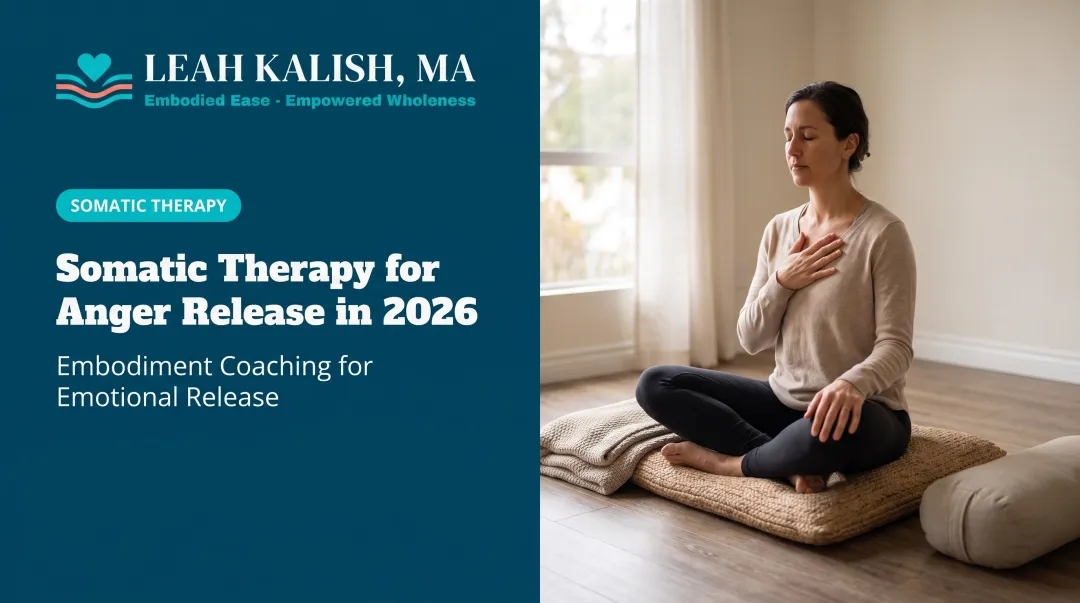
Place one hand on your chest, one on your belly. Inhale slowly through your nose, letting your belly hand rise while your chest hand stays still. Exhale slowly. Repeat for 5-10 rounds. This is the foundation most other techniques build on.
2. 4-7-8 Breathing
- Inhale through your nose for 4 counts
- Hold your breath for 7 counts
- Exhale through your mouth for 8 counts
One randomized study of post-surgery patients found this pattern reduced anxiety more than standard deep breathing. Useful before sleep or high-stress moments.
3. Box Breathing
- Inhale for 4 counts
- Hold for 4 counts
- Exhale for 4 counts
- Hold empty for 4 counts
Repeat for 3-4 rounds. The simple, equal-count structure makes it especially grounding when your thoughts are racing.

4. Cyclic Sighing (Extended Exhale)
- Take a normal inhale through your nose
- Add a second small "top-up" inhale
- Exhale slowly and fully through your mouth
A Stanford study on brief breathing practices found that just five minutes of this daily improved mood more than an equivalent amount of mindfulness meditation.
5. Body Scan Paired with Breath
Breathe slowly while mentally scanning from your feet to your head. When you hit a tense spot, pause and breathe into it for a few extra rounds before moving on. This is where somatic breathwork most clearly earns its name — you're using breath as a tool for noticing, not just calming.

Is Somatic Breathwork Safe? What to Know Before You Start
For most healthy adults, somatic breathwork is low-risk. But it isn't right for everyone.
Use extra caution, or skip it without guidance, if you have:
- Cardiovascular issues or a history of stroke
- Severe respiratory conditions such as advanced COPD
- Pregnancy
- Panic disorder or active panic attacks (symptoms can intensify before they ease)
- Other mental health conditions that make intense body sensations hard to tolerate
Fast-paced, high-ventilation styles warrant more caution than slow, gentle breathing. Rapid breathing can cause light-headedness, tingling, or a racing heartbeat in some people: not necessarily a sign of "release," but a cue to slow down.
If breathwork surfaces intense emotion, especially tied to trauma, that's a signal to seek guided support rather than push through alone.
Before starting, especially if you're processing deep trauma, adoption-related wounds, or grief, talk with a medical professional or trained facilitator first.
When Breathwork Isn't Enough: Going Deeper with Family Constellation Work
Daily breathwork helps many people regulate stress. Some patterns still sit deeper than breath alone can reach—family dynamics, adoption wounds, and generational stress that show up in the body without a clear personal origin.
Family Constellation work is built for that layer. It reveals inherited systemic patterns: unconscious loyalties and unresolved family history that often sit underneath chronic stress responses.
Leah and Bruce Kalish facilitate Family Constellations in Los Angeles and online, at the intersection of nervous system regulation and systemic trauma resolution. Leah was certified by Mark Wolynn, founder of the Family Constellation Institute, in 2009; the two have facilitated together since.
Wolynn has described them directly:
"Bruce and Leah are masterful facilitators, bringing warmth, depth, wisdom and compassion to those whose hearts they touch. Los Angeles is lucky to have them."
Clients often report meaningful shifts in a single session—breaking longstanding trauma patterns or feeling, as one client put it, "unstuck" for the first time in years. The Kalishes typically start with a Family Constellation session, then use Embodiment Process sessions so the body can integrate what surfaces.

This path fits if you are:
- An adoptee navigating identity or family-relationship questions
- Processing grief or a major life transition
- A clinician or helping professional seeking personal and clinical insight
- Feeling emotionally stuck despite consistent daily practices
For a low-commitment start, they periodically offer a free online introduction to Inherited Trauma & Family Constellations. A reduced-rate demonstration constellation is also available if you want a more direct first experience.
Frequently Asked Questions
What is somatic breathwork and how does it work?
Somatic breathwork is body-centered breathing that regulates your nervous system and processes stored tension. It pairs breath with body awareness to shift you out of stress states, rather than only calming the mind.
What is the difference between breathwork and somatic breathwork?
General breathwork is a broad category including spiritual, relaxation, and performance-based practices. Somatic breathwork specifically focuses on releasing body-stored emotion through breath paired with sensation tracking.
How does somatic breathwork help release trauma, and what does it feel like?
It helps complete unfinished stress responses by pairing breath with body sensation. You might feel waves of emotion, tingling, or shaking, or a gradual settling into calm, depending on your nervous system's state and history.
Is somatic breathwork legitimate and evidence-based?
Research supports physiological benefits like lower cortisol and improved heart rate variability from slow breathing practices. Trauma-specific evidence is still developing, so treat it as a complementary practice rather than a proven standalone treatment.
How do you get certified in somatic breathwork, and is certification worth it?
Various private training programs exist, some requiring hundreds of hours over multiple years. Certification matters if you plan to facilitate for others professionally, but it's not required for a personal daily practice.